

Feb . 11, 2026 00:01 Back to list
wholesale pvc pipe price per meter Performance Analysis
Introduction
Polyvinyl Chloride (PVC) pipe represents a ubiquitous material in modern infrastructure, serving diverse applications ranging from potable water distribution and wastewater conveyance to irrigation and drainage systems. The wholesale price per meter of PVC pipe is a critical factor in project budgeting, particularly for large-scale constructions. This technical guide will provide a comprehensive analysis of PVC pipe, detailing its material science, manufacturing processes, performance characteristics, common failure modes, and relevant industry standards. Understanding the nuances of PVC composition and production directly impacts pipe longevity, structural integrity, and ultimately, lifecycle costs. Fluctuations in raw material costs (ethylene and chlorine) and manufacturing efficiencies are key drivers of wholesale pricing. This document aims to equip industry professionals with the knowledge needed to assess PVC pipe quality and value beyond simply the per-meter cost.
Material Science & Manufacturing
PVC is a thermoplastic polymer formed through the polymerization of vinyl chloride monomer (VCM). The resulting resin is inherently rigid and brittle. To enhance its usability, plasticizers, stabilizers, lubricants, and other additives are incorporated. Common plasticizers, such as phthalates or increasingly, alternatives like DINP and DOTP, increase flexibility. Stabilizers (typically based on tin or calcium-zinc formulations) protect against thermal degradation during processing and UV exposure during service. Manufacturing PVC pipe commonly employs extrusion processes. PVC compound is fed into an extruder, where it is heated, melted, and forced through a die to create the desired pipe dimensions. Key process parameters include extruder screw speed, barrel temperature profile, die temperature, and cooling rates. Maintaining precise temperature control is critical to prevent degradation and ensure consistent material properties. Pipe schedules (e.g., Schedule 40, Schedule 80) define the wall thickness, which directly impacts pressure rating and structural strength. The quality of PVC compound, precise extrusion control, and proper cooling are paramount to achieving a high-quality final product. Chlorinated PVC (CPVC) is a modified version exhibiting improved temperature resistance and is used in hot water applications.
Performance & Engineering
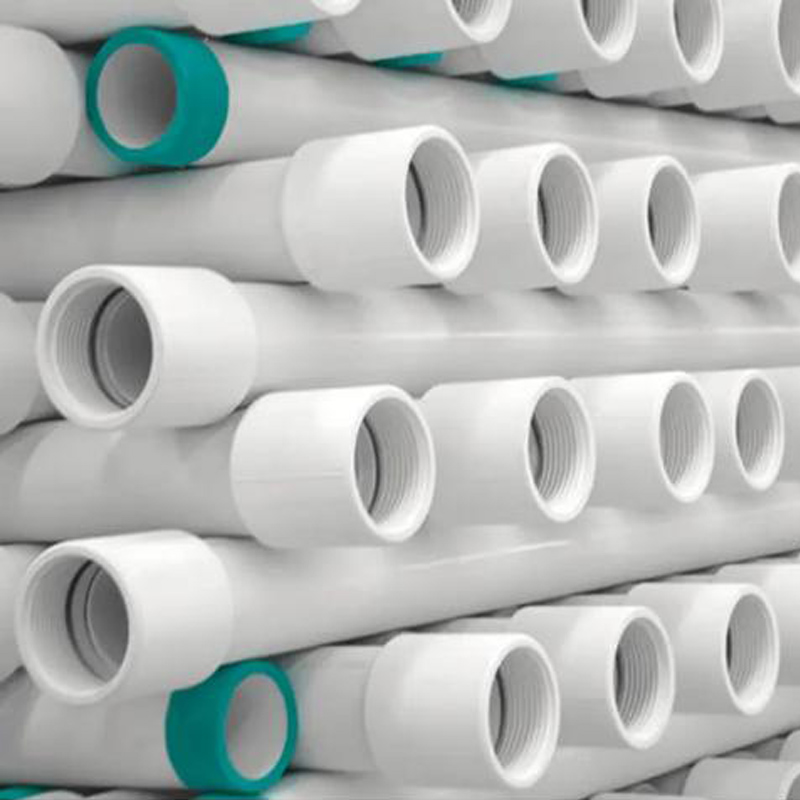
The performance of PVC pipe is largely dictated by its mechanical properties and resistance to environmental factors. Tensile strength, yield strength, and impact resistance are critical parameters assessed during quality control. PVC pipe is subjected to hydrostatic pressure testing to verify its ability to withstand internal pressure without failure. Long-term hydrostatic strength (LTHS) is a crucial metric indicating the sustained pressure capability over an extended period (typically 50 years). Environmental stress cracking (ESC) is a significant concern, particularly when PVC is exposed to sustained tensile stress in the presence of aggressive chemicals. UV degradation can lead to embrittlement and loss of impact resistance. Therefore, UV stabilizers are essential for outdoor applications. Soil loading is a crucial consideration in buried pipe applications. The pipe's ability to resist deflection and collapse under external loads from soil and traffic is critical. Finite element analysis (FEA) is frequently used to model pipe behavior under various loading conditions. Joint integrity is paramount. Solvent welding is the most common joining method, requiring proper surface preparation, solvent application, and curing time to create a watertight seal. Threaded connections, while less common, demand accurate threading and appropriate sealing compounds.
Technical Specifications
| Parameter | Schedule 40 (ASTM D1785) | Schedule 80 (ASTM D1785) | CPVC (ASTM D1785) |
|---|---|---|---|
| Material | PVC | PVC | CPVC |
| Pressure Rating (psi @ 73°F) | 200 | 350 | 400 |
| Temperature Rating (°F) | 140 | 140 | 180 |
| Tensile Strength (psi) | 6,000 - 7,500 | 6,000 - 7,500 | 7,500 - 9,000 |
| Impact Strength (ft-lb) | 10-15 | 12-18 | 8-12 |
| Hydrostatic Design Stress (HDS) (psi) | 4,000 | 5,800 | 6,000 |
Failure Mode & Maintenance
PVC pipe is susceptible to several failure modes. Environmental Stress Cracking (ESC) is a prevalent issue, particularly in applications involving sustained tensile stress combined with exposure to certain chemicals (e.g., some solvents, petroleum products). UV degradation leads to embrittlement and cracking, particularly in exposed sections. Thermal deformation can occur at elevated temperatures, leading to bowing or distortion. Mechanical damage from impacts during installation or excavation can cause cracking or punctures. Joint failures are common due to improper solvent welding techniques, inadequate surface preparation, or the use of incompatible solvents. Corrosion, while PVC itself is corrosion-resistant, can occur at metallic fittings or connections. Maintenance involves regular visual inspections for cracks, leaks, or deformation. Joints should be checked for tightness and evidence of solvent degradation. Protective coatings or shielding can mitigate UV exposure. Proper backfilling procedures are essential to prevent excessive soil loading. Prompt repair of any identified defects is crucial to prevent catastrophic failure. For CPVC, maintaining temperatures within the specified limits is critical to prevent softening and loss of strength. Pressure testing should be performed periodically to verify system integrity.
Industry FAQ
Q: What is the impact of phthalate plasticizers on PVC pipe performance and long-term durability?
A: Phthalate plasticizers, while historically common, have faced increasing scrutiny due to potential health and environmental concerns. They can migrate out of the PVC matrix over time, leading to embrittlement and reduced flexibility. This migration is accelerated by elevated temperatures and exposure to certain chemicals. Modern formulations increasingly utilize alternative plasticizers like DINP and DOTP, offering improved performance and reduced environmental impact. The choice of plasticizer significantly affects the long-term durability and lifecycle cost of the PVC pipe.
Q: How does the Schedule number (e.g., Schedule 40, Schedule 80) affect the cost per meter of PVC pipe?
A: The Schedule number directly correlates to the pipe wall thickness. Higher Schedule numbers (e.g., Schedule 80) have thicker walls, requiring more material to manufacture. This translates to a higher cost per meter. While the initial cost is higher, Schedule 80 pipe offers increased pressure rating and mechanical strength, which may be necessary for demanding applications and can ultimately reduce lifecycle costs by minimizing the risk of failure.
Q: What are the key differences between PVC and CPVC pipe, and when would CPVC be the preferred choice?
A: CPVC (Chlorinated Polyvinyl Chloride) offers significantly improved temperature resistance compared to standard PVC. While PVC is suitable for applications up to 140°F, CPVC can handle temperatures up to 180°F or higher. This makes CPVC the preferred choice for hot water distribution systems, industrial process piping, and other applications involving elevated temperatures. However, CPVC is generally more expensive than PVC and may have slightly lower impact resistance.
Q: What quality control measures should be implemented to ensure the integrity of solvent-welded PVC pipe joints?
A: Proper solvent welding is critical for joint integrity. Key quality control measures include verifying surface cleanliness and dryness, using the correct solvent for the specific PVC formulation, applying the solvent evenly and according to the manufacturer's instructions, and allowing sufficient curing time before pressurizing the system. Operator training and regular inspections are also essential.
Q: How do different soil conditions affect the long-term performance of buried PVC pipe, and what mitigation strategies can be employed?
A: Aggressive soil conditions, such as those containing high levels of sulfates or chlorides, can accelerate degradation of PVC pipe. Poorly compacted backfill can lead to uneven loading and potential pipe deflection or cracking. Mitigation strategies include using PVC pipe with enhanced chemical resistance, providing proper bedding and backfill compaction, and considering the use of protective coatings or wraps in highly corrosive environments.
Conclusion
The wholesale price per meter of PVC pipe is a significant economic consideration, but it should not be the sole determinant in material selection. A thorough understanding of the material’s properties, manufacturing processes, performance characteristics, and potential failure modes is essential for ensuring long-term reliability and minimizing lifecycle costs. Careful consideration of application-specific requirements, environmental factors, and adherence to relevant industry standards are crucial for optimal performance.
The evolution of PVC formulations, with a move towards phthalate-free plasticizers and enhanced UV stabilizers, is continually improving the durability and sustainability of this widely used material. Investing in high-quality PVC pipe from reputable manufacturers, coupled with proper installation and maintenance practices, will yield the most cost-effective and reliable long-term solution for various infrastructure applications.
-
DN25 HDPE Compression Fitting-HORON INTERNATIONAL|Reliable Irrigation Solutions
NewsFeb.11,2026
-
hdpe coupling joint product Manufacturing Analysis
News2026-11-18
-
ppr pipe heating time products Performance Analysis
News2026-11-16
-
hdpe pipe sizes factory Performance Analysis
News2026-11-09
-
HDPE Pipe Sizes Service Performance Analysis
News2026-10-26
-
wholesale 15mm ppr pipe Material Science and Performance Analysis
News2026-10-20
-
wholesale pvc pipe price per foot Technical Analysis
News2026-09-21
-
wholesale long pvc pipe Technical Analysis and Manufacturing Specifications
News2026-09-15
-
wholesale plumbing kitchen sink water lines Material Performance
News2026-09-15
-
wholesale hdpe drip irrigation Material Science
News2026-09-15
-
wholesale hot water ppr pipe Performance Analysis
News2026-09-15
-
wholesale ppr plumbing Performance Analysis
News2026-09-15
-
wholesale ppr pipe supplier Performance Analysis
News2026-09-13
-
wholesale 50mm ppr pipe Performance Analysis
News2026-09-13
-
wholesale hdpe drip pipe Performance Analysis
News2026-09-13
-
wholesale hdpe pipe 63mm price Manufacturing Specification and Performance Analysis
News2026-09-13