

Feb . 11, 2026 00:01 Back to list
china 6 double wall corrugated pipe Performance Analysis
Introduction
China 6 Double Wall Corrugated Pipe (DWCP) represents a significant advancement in subsurface drainage and infrastructure solutions. Classified as a rigid, annular structure, it is primarily utilized for stormwater management, sanitary sewer applications, and as conduit for utilities. Positioned within the broader piping industry, it offers a compelling alternative to traditional materials like concrete, PVC, and HDPE, particularly in applications demanding high load-bearing capacity, durability, and resistance to environmental stressors. Its ‘6’ designation refers to its structural classification, indicating a standardized level of ring stiffness optimized for specific burial depths and load requirements. Core performance characteristics include high compressive strength, exceptional long-term hydraulic capacity, and a smooth interior surface minimizing flow restriction. A primary industry pain point addressed by DWCP is the longevity and maintenance costs associated with aging concrete infrastructure, alongside the limitations of traditional plastic pipes in high-load applications.
Material Science & Manufacturing
The primary material for China 6 DWCP is polypropylene (PP), specifically high-density polypropylene (HDPE) grades with impact modifiers. PP is chosen for its excellent chemical resistance, lightweight characteristics, and processability. The manufacturing process begins with PP resin pellets undergoing extrusion. This involves melting the pellets and forcing them through a circular die to form a continuous PP sheet. The sheet is then heated and formed around a mandrel using vacuum forming or pressure forming techniques, creating the corrugated profile. Crucially, a smooth inner wall is formed simultaneously. Two such corrugated sheets are then adhered together using hot-air welding or ultrasonic welding to create the double-wall structure, enhancing ring stiffness. Key parameter control involves maintaining precise melt temperatures during extrusion (typically 230-250°C), controlling the vacuum/pressure levels during forming to ensure consistent corrugation geometry, and maintaining weld integrity. The molecular weight distribution of the PP resin significantly impacts impact resistance, requiring stringent quality control measures. Additives, such as UV stabilizers and antioxidants, are incorporated into the PP resin to mitigate long-term degradation from sunlight exposure and thermal oxidation. The corrugated profile’s geometry – depth and pitch – directly influence its structural performance, necessitating precise die design and process control.
Performance & Engineering
The performance of China 6 DWCP is governed by principles of structural mechanics, hydraulics, and material science. Force analysis involves assessing the pipe’s ability to withstand external loads, including soil overburden, traffic loads (HS-20 loading standards are typically applied), and hydrostatic pressure. The ring stiffness (measured in psi) is a critical parameter, defining the pipe's resistance to deformation under these loads. Finite Element Analysis (FEA) is commonly employed during the design phase to optimize the corrugated profile and wall thickness for maximum load-bearing capacity. Environmental resistance is paramount. PP is generally resistant to most acids, bases, and salts encountered in typical soil environments. However, prolonged exposure to oxidizing agents should be avoided. Compliance requirements are defined by ASTM F2306 (Standard Specification for Smooth-Wall Polyolefin Drainage Pipe) and regional building codes. Hydraulic performance is characterized by Manning's roughness coefficient, which for DWCP is typically very low (n ≈ 0.012), indicating minimal flow resistance. Joint integrity is crucial; bell-and-spigot joints with gasket seals are standard, ensuring watertight connections. The long-term creep behavior of PP must be considered, particularly under sustained loads. Creep is the tendency of a solid material to move slowly or deform permanently under the influence of persistent mechanical stresses. The pipe’s ability to maintain its structural integrity over a 50-year service life is a key engineering consideration.
Technical Specifications
| Parameter | Units | China 6 DWCP (Typical) | ASTM F2306 Minimum |
|---|---|---|---|
| Nominal Diameter | inches | 12 – 60 | 12 – 60 |
| Ring Stiffness | psi | 60 - 75 | 48 |
| Material | - | Polypropylene (PP) | Polypropylene (PP) or Polyethylene (PE) |
| Wall Thickness (Double Wall) | inches | 0.75 – 1.5 | 0.6 - 1.2 |
| Manning’s Roughness Coefficient | - | 0.012 | ≤ 0.015 |
| Long-Term Soil Cover Load | feet | Up to 20 | As per load rating |
Failure Mode & Maintenance
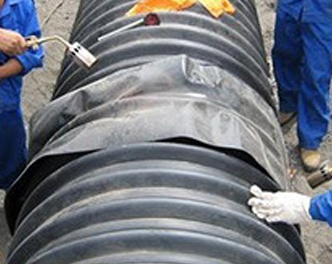
Common failure modes in China 6 DWCP include creep rupture, cracking due to excessive load, joint failure, and environmental stress cracking (ESC). Creep rupture occurs under sustained compressive loads over extended periods, leading to gradual deformation and eventual failure. Cracking can result from impact damage during installation or from localized stress concentrations. Joint failure, typically associated with gasket degradation or improper installation, leads to leakage. ESC is initiated by the combined action of tensile stress, aggressive chemicals in the surrounding soil, and a susceptible polymer. Failure analysis often involves visual inspection for cracks, deformation, or joint separation, as well as laboratory testing to determine the material’s mechanical properties and identify the root cause of failure. Preventative maintenance includes ensuring proper installation techniques (including adequate bedding and backfill compaction), avoiding excessive point loads, and protecting the pipe from exposure to aggressive chemicals. Regular inspection of joints is recommended. In the event of minor cracking, repair sleeves or wraps can be used to reinforce the damaged area. Significant structural damage typically necessitates pipe replacement. Proper storage of DWCP before installation is also critical to prevent UV degradation.
Industry FAQ
Q: What is the advantage of China 6 DWCP over traditional concrete pipe in terms of installation?
A: China 6 DWCP is significantly lighter than concrete pipe, reducing the need for heavy lifting equipment and accelerating installation times. Its flexibility also simplifies alignment in challenging terrain, and it is pre-fabricated, eliminating on-site construction requirements.
Q: How does the ring stiffness of DWCP affect its application suitability?
A: Higher ring stiffness indicates greater resistance to deformation under load. China 6 DWCP, with its specified ring stiffness, is suitable for burial depths and traffic loads where a robust structural performance is required. Selecting the correct ring stiffness is crucial to prevent pipe collapse.
Q: What measures should be taken to prevent environmental stress cracking in DWCP?
A: Avoid direct contact with strong oxidizing agents and ensure proper bedding and backfill materials are used to distribute loads and minimize stress concentrations. Utilize appropriate gasket materials compatible with the surrounding soil chemistry.
Q: What are the typical jointing methods used with China 6 DWCP, and what considerations are important for long-term performance?
A: Bell-and-spigot joints with elastomeric gaskets are most common. Proper gasket selection (based on chemical compatibility and temperature range), correct joint assembly (following manufacturer’s instructions), and adequate compaction of the surrounding backfill are all critical for ensuring long-term watertightness.
Q: Can DWCP be used in applications involving significant chemical exposure, such as industrial wastewater?
A: While PP offers good chemical resistance, the specific chemicals present and their concentrations must be carefully evaluated. Consulting a chemical compatibility chart and conducting laboratory testing are recommended to ensure the pipe material is suitable for the application.
Conclusion
China 6 Double Wall Corrugated Pipe offers a compelling solution for a wide range of drainage and utility applications, driven by its combination of high strength-to-weight ratio, durability, and ease of installation. Its polypropylene-based construction provides excellent chemical resistance and hydraulic performance, addressing many of the shortcomings of traditional materials. Selecting the appropriate ring stiffness and ensuring proper installation practices are paramount to realizing its full potential and maximizing service life.
Looking forward, continued advancements in PP resin technology, including the development of enhanced impact modifiers and UV stabilizers, will further improve the long-term performance and broaden the application scope of DWCP. Further research into the creep behavior of PP under various loading conditions and environmental factors will be crucial for refining design guidelines and ensuring the structural integrity of DWCP installations for decades to come.
-
DN25 HDPE Compression Fitting-HORON INTERNATIONAL|Reliable Irrigation Solutions
NewsFeb.11,2026
-
china hdpe reducer coupling Performance Analysis
News2026-05-06
-
china ppr pipe cost Performance Analysis
News2026-05-06
-
china pvc pipe for sale Performance Analysis
News2026-05-06
-
china 6 double wall corrugated pipe Performance Analysis
News2026-05-06
-
china hdpe conduit fittings Performance Analysis
News2026-05-06
-
china pvc pipe class 7 Performance Analysis
News2026-05-05
-
china 63mm pvc pipe Performance Analysis
News2026-05-05
-
china hdpe to steel transition coupling Performance Analysis
News2026-05-05
-
china kitchen water pipe Performance Analysis
News2026-05-05
-
china ppr 14 pipe Performance Analysis
News2026-05-05
-
china hdpe pipe for drip irrigation Performance Analysis
News2026-05-04
-
china hdpe pipe for agriculture Performance Analysis
News2026-05-04
-
china hdpe sprinkler pipe price Performance Analysis
News2026-05-04
-
china 2 ppr pipe Performance Analysis
News2026-05-04
-
china pvc pipe price per foot Performance Analysis
News2026-05-04