

Feb . 11, 2026 00:01 Back to list
hdpe conduit fittings factories Performance Analysis

Introduction
High-Density Polyethylene (HDPE) conduit fittings are critical components in modern infrastructure, specifically designed for protecting and routing electrical, data, and telecommunications cables. These fittings, manufactured by specialized factories, interface with HDPE conduit to create a complete and secure raceway system. Their technical position within the construction and utilities supply chain is downstream from the HDPE resin production and pipe extrusion processes. Core performance characteristics revolve around impact resistance, long-term durability in harsh environments, and consistent dimensional accuracy to ensure watertight and mechanically sound connections. The industry currently faces challenges related to maintaining consistent material quality across suppliers, optimizing fitting designs for varying cable densities, and adapting to evolving regulatory requirements surrounding grounding and cable protection. These fittings address a substantial need for robust and reliable cable management, moving beyond traditional metal conduits in applications where corrosion resistance and weight reduction are paramount.
Material Science & Manufacturing
HDPE conduit fittings primarily utilize high-density polyethylene resin, typically grades designated for injection molding. The raw material exhibits a semi-crystalline structure, granting it both flexibility and toughness. Critical material properties include a density ranging from 0.941 to 0.965 g/cm³, a tensile strength of 20-30 MPa, and a relatively low water absorption rate (<0.01%). Manufacturing predominantly employs injection molding. The process begins with HDPE pellets being melted and injected into a closed mold under high pressure (typically 70-140 MPa). Mold temperatures are carefully controlled (around 60-90°C) to influence crystallization rate and prevent warping. Cooling time is crucial to minimize shrinkage and maintain dimensional tolerances. Critical parameters include melt temperature, injection speed, holding pressure, and cooling rate. Secondary operations such as deburring and quality control inspections (dimensional checks, visual defect analysis) are essential. The long-term performance is directly tied to the molecular weight distribution of the HDPE resin and the avoidance of thermal degradation during processing. Material compatibility with commonly used cable jacketing materials (PVC, XLPE) is also a key consideration to prevent stress cracking or chemical interactions. Some fittings incorporate UV stabilizers to mitigate degradation from prolonged sun exposure.
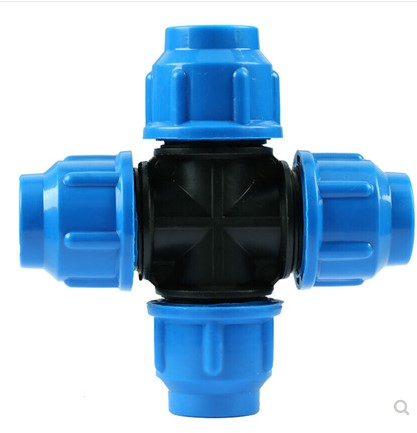
Performance & Engineering
The performance of HDPE conduit fittings is dictated by several engineering considerations. Impact resistance is paramount, particularly during installation and in environments prone to physical stress. Fittings must withstand specified impact energy levels as defined by UL 797 and IEC 68-2-6 standards. Force analysis focuses on pull-out strength, which assesses the fitting's ability to retain the conduit under tensile load. This is influenced by the interference fit between the conduit and fitting, as well as the fitting’s geometry. Environmental resistance is critical; HDPE exhibits excellent resistance to most chemicals, but prolonged exposure to strong oxidizing agents should be avoided. Temperature fluctuations cause thermal expansion and contraction; fittings are engineered to accommodate these dimensional changes without compromising the seal. Compliance requirements include adherence to National Electrical Code (NEC) Article 352 for conduit installations, and ensuring proper grounding continuity. Fittings often incorporate features to facilitate grounding wire attachment. The design also needs to account for the bending radius of the conduit to avoid kinking and maintain internal cable integrity. Finite element analysis (FEA) is frequently employed to optimize fitting geometries for stress distribution and maximize mechanical performance.
Technical Specifications
| Parameter | Units | Typical Value (1.5" Fitting) | Testing Standard |
|---|---|---|---|
| Nominal Size | inches | 1.5 | ANSI/ASME B1.20.1 |
| Material | - | HDPE (PE100) | ASTM D3350 |
| Impact Strength (23°C) | Joule | 8-12 | UL 797 |
| Tensile Strength | MPa | 25 | ASTM D638 |
| Water Absorption (24hr) | % | <0.1 | ASTM D570 |
| Operating Temperature Range | °C | -40 to +85 | ASTM D790 |
Failure Mode & Maintenance
HDPE conduit fittings, while durable, are susceptible to specific failure modes. Environmental Stress Cracking (ESC) can occur due to exposure to certain chemicals or sustained tensile stress, leading to premature cracking. UV degradation, particularly in fittings lacking adequate stabilization, results in embrittlement and loss of impact resistance. Fatigue cracking can develop in fittings subjected to repeated bending or vibration. Delamination can occur if the HDPE material is improperly molded or contaminated. Oxidation, while less common in HDPE than in some other polymers, can occur at elevated temperatures and lead to a reduction in mechanical properties. Maintenance primarily focuses on visual inspections for cracks, deformation, or discoloration. Periodic cleaning to remove dirt and debris is recommended. Avoid using harsh solvents or abrasive cleaners, as these can accelerate degradation. For installations in corrosive environments, consider using fittings with enhanced chemical resistance. If damage is detected, the fitting should be replaced immediately. Proper installation practices – avoiding over-tightening and ensuring correct conduit alignment – are crucial for preventing premature failure. Grounding connections should be inspected regularly for corrosion and secure attachment.
Industry FAQ
Q: What is the advantage of HDPE fittings over metallic conduits in corrosive environments?
A: HDPE fittings offer significantly superior corrosion resistance compared to metallic conduits like galvanized steel or aluminum. Metals corrode when exposed to moisture, salts, and certain chemicals, leading to structural weakening and potential failure. HDPE is inherently resistant to these corrosive agents, ensuring long-term reliability and reduced maintenance costs in harsh environments. The absence of metallic pathways also eliminates galvanic corrosion concerns when dissimilar metals are in contact.
Q: How do HDPE fittings handle thermal expansion and contraction?
A: HDPE has a higher coefficient of thermal expansion than metal. Fittings are designed with sufficient flexibility and utilize interference fits to accommodate thermal movement without compromising the seal. Proper installation, allowing for some degree of "float" within the system, is crucial. Larger diameter conduits and longer runs will exhibit greater thermal expansion, necessitating careful consideration during design and installation.
Q: What is the role of UV stabilizers in HDPE fittings?
A: UV stabilizers are additives incorporated into the HDPE resin to protect it from degradation caused by ultraviolet radiation from sunlight. Prolonged UV exposure can cause HDPE to become brittle and lose impact resistance. UV stabilizers absorb or reflect UV radiation, extending the service life of the fittings in outdoor applications. The concentration of UV stabilizers is tailored to the expected level of sun exposure.
Q: Are HDPE conduit fittings suitable for direct burial applications?
A: Yes, HDPE conduit fittings are well-suited for direct burial applications, provided they meet the relevant industry standards and regulations (e.g., NEC Article 352). The inherent corrosion resistance of HDPE eliminates the risk of soil-induced corrosion. However, it's crucial to use fittings specifically designed for direct burial, which may include features like increased wall thickness and enhanced impact resistance. Proper bedding and backfill materials are also essential for protecting the conduit system.
Q: What is the typical service life expectancy of an HDPE conduit fitting system?
A: The service life expectancy of an HDPE conduit fitting system can exceed 50 years under normal operating conditions and with proper installation and maintenance. Factors influencing lifespan include the quality of the HDPE resin, the level of UV exposure, the severity of the environment (e.g., temperature, chemical exposure), and the degree of mechanical stress. Regular inspections and adherence to recommended maintenance practices will help maximize service life.
Conclusion
HDPE conduit fittings represent a significant advancement in cable management technology, offering a compelling combination of durability, corrosion resistance, and ease of installation. Their inherent material properties and optimized manufacturing processes address critical industry pain points related to long-term reliability and maintenance costs. The ability to withstand harsh environmental conditions and accommodate thermal expansion and contraction makes them ideal for a wide range of applications, from underground utilities to industrial facilities.
Looking ahead, continued innovation in HDPE resin formulations, fitting designs, and installation techniques will further enhance the performance and longevity of these systems. Adoption of smart monitoring technologies to detect early signs of degradation and optimize maintenance schedules will also play an increasingly important role. Ultimately, the continued success of HDPE conduit fittings hinges on adherence to rigorous quality control standards and a commitment to providing solutions that meet the evolving needs of the infrastructure industry.
-
DN25 HDPE Compression Fitting-HORON INTERNATIONAL|Reliable Irrigation Solutions
NewsFeb.11,2026
-
hdpe coupling joint product Manufacturing Analysis
News2026-11-18
-
ppr pipe heating time products Performance Analysis
News2026-11-16
-
hdpe pipe sizes factory Performance Analysis
News2026-11-09
-
HDPE Pipe Sizes Service Performance Analysis
News2026-10-26
-
wholesale 15mm ppr pipe Material Science and Performance Analysis
News2026-10-20
-
wholesale pvc pipe price per foot Technical Analysis
News2026-09-21
-
wholesale long pvc pipe Technical Analysis and Manufacturing Specifications
News2026-09-15
-
wholesale plumbing kitchen sink water lines Material Performance
News2026-09-15
-
wholesale hdpe drip irrigation Material Science
News2026-09-15
-
wholesale hot water ppr pipe Performance Analysis
News2026-09-15
-
wholesale ppr plumbing Performance Analysis
News2026-09-15
-
wholesale ppr pipe supplier Performance Analysis
News2026-09-13
-
wholesale 50mm ppr pipe Performance Analysis
News2026-09-13
-
wholesale hdpe drip pipe Performance Analysis
News2026-09-13
-
wholesale hdpe pipe 63mm price Manufacturing Specification and Performance Analysis
News2026-09-13