

Feb . 11, 2026 00:01 Back to list
63mm pvc pipe product Manufacturing Analysis

Introduction
63mm Polyvinyl Chloride (PVC) pipe is a rigid plastic pipe widely utilized in a variety of applications including potable water distribution, irrigation, drainage, venting, and certain industrial fluid transfer systems. Its position within the construction and infrastructure supply chain is fundamental, serving as a cost-effective and durable alternative to metallic piping systems. Characterized by its resistance to corrosion, chemical attack, and ease of installation, 63mm PVC pipe offers a significant lifespan with minimal maintenance. Core performance attributes include its pressure rating, impact strength, and ability to maintain structural integrity across a wide temperature range. This guide provides an in-depth analysis of 63mm PVC pipe, covering material science, manufacturing processes, performance characteristics, potential failure modes, and relevant industry standards. A key industry pain point revolves around long-term soil stress cracking and the selection of appropriate PVC compounds for varying environmental conditions and chemical exposures.
Material Science & Manufacturing
63mm PVC pipe is primarily manufactured from Polyvinyl Chloride resin, a thermoplastic polymer produced through the polymerization of vinyl chloride monomer (VCM). The resin’s physical properties—including molecular weight, glass transition temperature (Tg) and degree of polymerization—directly influence the final product’s performance. Typically, PVC formulations incorporate stabilizers (e.g., tin mercaptides, calcium-zinc stabilizers), lubricants (e.g., stearates), impact modifiers (e.g., chlorinated polyethylene – CPE), and processing aids to enhance workability and long-term durability. The raw material’s chemical composition must adhere to stringent purity standards to prevent degradation and maintain consistent mechanical properties.
Manufacturing commonly employs the extrusion process. PVC compound is fed into a single-screw extruder, where it is heated and plasticized. The molten PVC is then forced through a die that shapes it into a 63mm diameter pipe. Critical process parameters include barrel temperature profiling, screw speed, and die pressure. Precise control of these parameters is essential to ensure uniform wall thickness, dimensional accuracy, and a smooth internal and external surface finish. Following extrusion, pipes are cooled, calibrated (to maintain dimensional tolerances), and cut to specified lengths. Further quality control involves hydrostatic pressure testing to verify burst resistance and leak-proof joints. The material's inherent susceptibility to UV degradation necessitates the addition of UV stabilizers in formulations intended for above-ground applications.
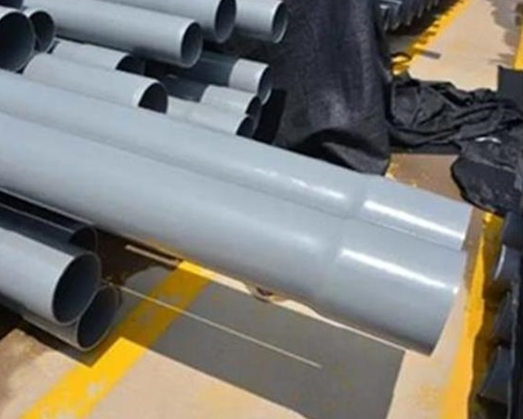
Performance & Engineering
The performance of 63mm PVC pipe is fundamentally governed by its ability to withstand internal hydrostatic pressure, external loads (soil loading, traffic loads), and environmental stressors. Force analysis reveals that hoop stress (stress circumferentially around the pipe) is the dominant stress under internal pressure, dictating the minimum required wall thickness for a given pressure rating. External loads induce bending stresses and radial compression, which can lead to pipe deformation or failure. Engineering design considerations include soil stiffness (modulus of elasticity) and burial depth to accurately assess external load distribution.
Environmental resistance is a crucial factor. PVC exhibits excellent resistance to a wide range of chemicals, including acids, bases, and salts, making it suitable for various industrial applications. However, prolonged exposure to certain organic solvents and chlorinated hydrocarbons can cause swelling and degradation. Temperature fluctuations also impact performance, with PVC becoming more brittle at lower temperatures and potentially softening under excessive heat. Compliance with relevant standards (e.g., ASTM D1785, EN 1452) ensures that pipes meet minimum requirements for pressure rating, impact strength, and dimensional accuracy. The long-term creep resistance of PVC is a critical consideration for applications involving sustained pressure.
Technical Specifications
| Parameter | Unit | Typical Value (Schedule 40) | Typical Value (Schedule 80) |
|---|---|---|---|
| Nominal Pipe Size | mm | 63 | 63 |
| Outside Diameter | mm | 63.5 | 63.5 |
| Wall Thickness | mm | 3.2 | 4.2 |
| Pressure Rating (at 23°C) | MPa | 1.0 | 1.6 |
| Tensile Strength | MPa | 55 | 55 |
| Impact Strength (Izod Notched) | kJ/m2 | 5 | 7 |
| Water Absorption (24 hrs) | % | <0.1 | <0.1 |
Failure Mode & Maintenance
63mm PVC pipe, while durable, is susceptible to several failure modes. Stress cracking, particularly in buried applications, occurs due to sustained tensile stress combined with aggressive soil chemistry. Fatigue cracking can develop under cyclic pressure or mechanical loading. UV degradation leads to embrittlement and surface cracking in above-ground exposures. Impact damage can occur during handling or installation. Joint failures frequently result from improper solvent cementing techniques or inadequate surface preparation. Thermal deformation can lead to leaks or structural compromise in high-temperature environments. A critical failure mode is slow crack growth (SCG), exacerbated by residual stresses and the presence of certain chemicals.
Preventative maintenance includes proper installation techniques (solvent cementing per ASTM D3139), adequate bedding and backfill support to minimize stress, and protection from UV exposure. Regular visual inspections should be conducted to identify signs of cracking, deformation, or joint leakage. If damage is detected, localized repairs using compatible PVC fittings and cement are recommended. For significant failures, pipe replacement is often necessary. Conducting a thorough soil analysis to identify potentially aggressive chemicals is crucial for long-term durability, and selecting the appropriate PVC compound accordingly is vital. Periodic hydrostatic testing can assess the ongoing integrity of the system.
Industry FAQ
Q: What is the impact of soil acidity on the long-term performance of buried 63mm PVC pipe?
A: High soil acidity can accelerate the degradation of PVC, particularly through stress cracking. Acidic conditions can leach stabilizers from the PVC compound, reducing its resistance to tensile stress and increasing susceptibility to cracking. The severity of the effect depends on the pH level, soil composition, and the type of stabilizer used in the PVC formulation. Choosing a PVC compound formulated with calcium-zinc stabilizers, which exhibit better resistance to acidic environments, is recommended for acidic soil conditions.
Q: How does temperature affect the pressure rating of 63mm PVC pipe?
A: The pressure rating of PVC pipe decreases as temperature increases. This is because PVC loses strength and stiffness at elevated temperatures. Pressure ratings are typically specified at 23°C. Derating factors, outlined in standards like ASTM D1785, must be applied when operating at higher temperatures. For example, a pipe rated for 1.0 MPa at 23°C may have a significantly lower allowable pressure at 60°C.
Q: What are the best practices for solvent cementing 63mm PVC pipe joints?
A: Proper solvent cementing is critical for leak-proof joints. Surfaces must be clean, dry, and free of contaminants. Use a primer specifically designed for PVC. Apply a uniform coat of primer to both the pipe and fitting surfaces. Immediately apply a sufficient amount of cement, ensuring complete coverage and capillary action. Avoid excessive cement, as it can weaken the joint. Allow adequate curing time before pressurizing the system, following the cement manufacturer’s instructions.
Q: Can 63mm PVC pipe be used for transporting potable water?
A: Yes, provided the PVC compound meets the requirements of relevant potable water standards, such as NSF/ANSI 61. These standards ensure that the PVC material does not leach harmful contaminants into the water supply. NSF-certified PVC pipe is specifically formulated and tested for potable water applications.
Q: What is the difference between Schedule 40 and Schedule 80 PVC pipe, and when should each be used?
A: Schedule 40 and Schedule 80 refer to the pipe wall thickness. Schedule 80 has a thicker wall than Schedule 40, resulting in a higher pressure rating and greater impact resistance. Schedule 40 is typically used for lower-pressure applications, such as irrigation and drainage. Schedule 80 is preferred for higher-pressure systems, industrial applications, and situations where greater mechanical strength is required. The choice depends on the specific application’s pressure, temperature, and load requirements.
Conclusion
63mm PVC pipe represents a robust and cost-effective solution for a wide range of fluid conveyance applications. Its performance is directly linked to the properties of the PVC compound, the precision of the manufacturing process, and adherence to established engineering principles. Understanding the potential failure modes, such as stress cracking and UV degradation, is essential for ensuring long-term reliability. Careful material selection, proper installation techniques, and routine maintenance are crucial for maximizing the service life of PVC piping systems.
Future advancements in PVC technology may focus on developing compounds with enhanced resistance to aggressive chemicals and improved creep resistance. Furthermore, the integration of smart sensors into PVC pipe systems could enable real-time monitoring of pressure, temperature, and structural integrity, facilitating proactive maintenance and preventing catastrophic failures. The continued refinement of PVC formulations and installation practices will solidify its position as a key material in infrastructure development.
-
DN25 HDPE Compression Fitting-HORON INTERNATIONAL|Reliable Irrigation Solutions
NewsFeb.11,2026
-
hdpe coupling joint product Manufacturing Analysis
News2026-11-18
-
ppr pipe heating time products Performance Analysis
News2026-11-16
-
hdpe pipe sizes factory Performance Analysis
News2026-11-09
-
HDPE Pipe Sizes Service Performance Analysis
News2026-10-26
-
wholesale 15mm ppr pipe Material Science and Performance Analysis
News2026-10-20
-
wholesale pvc pipe price per foot Technical Analysis
News2026-09-21
-
wholesale long pvc pipe Technical Analysis and Manufacturing Specifications
News2026-09-15
-
wholesale plumbing kitchen sink water lines Material Performance
News2026-09-15
-
wholesale hdpe drip irrigation Material Science
News2026-09-15
-
wholesale hot water ppr pipe Performance Analysis
News2026-09-15
-
wholesale ppr plumbing Performance Analysis
News2026-09-15
-
wholesale ppr pipe supplier Performance Analysis
News2026-09-13
-
wholesale 50mm ppr pipe Performance Analysis
News2026-09-13
-
wholesale hdpe drip pipe Performance Analysis
News2026-09-13
-
wholesale hdpe pipe 63mm price Manufacturing Specification and Performance Analysis
News2026-09-13